Thursday, January 22, 2026

Ritual Path Magic- Charms Granularity

Some options that add additional grit to charms. 


Charms

By default charms are lightweight and fragile items meant to be destroyed quickly via a Ready maneuver to activate a spell- glass/ceramic tokens, origami, thin cloth, etc.
 
As such, Charms can be safely assumed to have 1 HP and no Damage Resistance, although it could be argued that Toxic and Fatigue damage shouldn't damage inanimate objects and therefore charms, but YMMV.

Given the fragility of charms, GMs might rule that they are subject to possibly being destroyed inadvertently by large-area attacks, explosions, or falls.

DF2 gives a roughly 2/3rd chance (rolls of 1-4 on 1d) of potions and grenades being destroyed when the containers they are within are bashed. I find that percentage (~15%) to be a smidge high for Charms on a person's body. The description of a quick-release backpack in DF1 suggests that breakables break on a roll of 1 on 1d6 which seems more reasonable overall.

Breakage of Charms:

Large-Area Injury, Explosions, and Falls have a chance of breaking- and thus activating- charms. Explosions and Large-Area Injuries must first penetrate the DR of both the character carrying the charms and the container that the charms are within (if any), but such DR does not apply to charms stored on the exterior of one's body! 

Falls must be large enough to actually deal damage- catfall, acrobatics, feather fall and other mitigations protect normally, but Damage Resistance does not.
 
Roll 3d6 for each charm individually, on a 6 or less the charm is broken and activates, immediately applying its relevant effects as if cast.

Specialized protective containers with the cushioned modifier are designed to minimize breakage and reduce the chance of breakage to a roll of 3 on 3d6. 

Rugged Charms

Charms can be constructed out of more rugged materials to mitigate the chances of accidental activation. Rugged charms have Injury Tolerance (Homogeneous), and each drawback taken gives the charm an additional HP 1, and DR 6. Which drawbacks apply must be selected when the charm is first created.

Rugged Charm Drawbacks:
  • Longer Preparation time- a full hour instead of half an hour, as more resilient materials take longer to impregnate with magic
  • Rugged charms cost 1 FP to activate, representing charms set off by a trickle of specific magical energy
  • Rugged Charms take 2 (or more) Ready Actions to Activate, representing fail safes and other measures meant to prevent the accidental activation of especially dangerous spells

Attacking Charms Directly

Charms can likely be assumed to be roughly 1-2 inches in size, which gives a mighty -9 to -11 Size Modifier penalty to-hit. Larger charms should have smaller penalties (e.g: dream-catchers, paper fans, etc).

Whoever is holding a charm that comes under attack may defend normally, but may not parry with the hand holding the charm.

Large-Area attacks such as cones, explosions, and such do not suffer the to-hit penalty from size modifier.

Stealing Charms

Attempting to snatch or wrangle a charm from the hand of someone is possible.
 
Doing such requires a Regular Contest with Sleight of Hand at -4 (for targeting the hand) against the target's DX (or Sleight of Hand if higher). I suggest a Regular Contest as opposed to a quick contest given how pivotal stealing a charm can be.

Alternatively, one may attempt a theft after successfully grappling the limb holding the charm, and then winning a Regular Contest of ST or DX or Sleight of hand vs. the Target's DX, ST, or Sleight of Hand.

At the GM's discretion a caster might be able to activate a charm after being grappled before the grappler can attempt a theft.
 
Targeted Attack (Hands) is probably a valid technique for Sleight of Hand to reduce the penalty to -2 when attempting to steal charms. For more cinematic games a technique could be allowed to buy off the entire -4 penalty.

Fast-Drawing Charms

Charms stored on the exterior of one's body, belts, or bandoliers give no penalty to fast-draw. Belts and bandoliers protect their contents with their DR (if any).

Charms in pockets give a -1 to fast draw, but the charms benefit from the DR of the garment they are stored in.

Charms stored in internal jacket pockets give a -2 to fast draw, but the charms benefit from garment DR and give a +2 bonus to Holdout to prevent the charms being discovered during a frisk.

Charms stored under armor give a -4 penalty to fast-draw, but benefit from all DR and have a +4 bonus to Holdout to avoid being discovered during a frisk.

Charm Gear:

As container DR contributes to defense against accidental destruction of charms, the rugged modifier from Low and High-tech can be applied to storage containers meant for charms.

Rugged:
Cost Modifier is +2. Weight increases by 1.2x. Container HT +2, and double DR (or increase DR to 2 if DR is initially 0)

Cushioned:
Reduces the chance of accidental breakage. Charms break on a roll of 3 on 3d6 instead of a 6 or lower on 3d6.
 
Cost Modifier is +2, no changes to weight or other stats.

Quick-Access:
Gives +1 to fast-draw when applied to particular garment or container. May only be applied once to a particular piece of gear, but bonuses from multiple articles with the modifier can stack to offset penalties, with a maximum bonus of +1 after negating penalties.

Cost Modifier is +2.

All three modifiers are compatible with one another.
 

Saturday, September 18, 2021

RPM Mistakes- some made, some avoided

My brother moved across the country a few months ago, and to help deal with his social isolation he got up the energy to convince me and some other family members to start a new GURPS campaign. It's been going swimmingly, recaps may or may not be in the works.

That said, it's been a long time since I've GMed a campaign that uses Ritual Path Magic (and the last time the only PC caster was using alchemy), which means it's a perfect opportunity to go over mistakes we've made, as well as pitfalls we've avoided that have come up in play.


Delivering a Spell via Melee Attack is not a Free Lunch

I choose to accept a very broad reading of page 17 of Thaumatology: Ritual Path Magic to allow attaching a spell to an attack:

Once created, the missile has to be delivered by touch
(using DX, Brawling, etc.)
Activating a charm requires a full Ready maneuver. Before we realized this the resident mage was thwacking people with his staff and loading additional spell damage beyond what would've been reasonable given the overall action economy of the game.

Yes, you can put a conditional on the weapon so that a spell takes place when it hits, but short of extremely careful preparation of conditional triggers (good luck convincing your GM to let that slide), you're looking at being one and done as far as those go.

Even the option presented in Pyramid #3-66 The Laws of Magic for Charm 'R' Us doesn't get around this - a ritual charm meant to deal damage after a melee attack still has to be activated with a Ready maneuver, even if the charms inhabit a physical wand or staff, or other object.

For those wondering why delivering a RPM spell via melee attack is still an appealing option:
  1. Cheaper than adding range and subject weight for internal damage
  2. No range penalties from attempting to utilize a missile for external damage
  3. Having actual melee weapon skill allows for better parry than raising Innate Attack skill
Important note: Compartmentalized Mind has no interaction with charms themselves due to the requirement of a Ready Maneuver.


Tapping Energy Reserve is a Free Lunch

Tapping Energy Reserve takes a Concentrate maneuver, meaning that as long as you tapped enough energy for the full spell cost, the spell happens immediately.

On the caster’s turn in which the last necessary point of energy has been acquired, he rolls against the appropriate Path skill (Choose the Skill, pp. 19-20) to cast the spell.

Blurring the Lines between Conditionals and Charms is a Bad Idea

Initially, I waffled on how concretely to treat Charms, whether they were physical objects, or something more akin to Vancian Magic where you just prep the spell ahead of time and then get to activate them at will.

Ultimately, forcing Charms to be physical objects that must be readied to use became important to ensuring that mages don't become magic machineguns, dishing our 7d of damage turn after turn after turn. This also introduces potential counter-play (by creating opportunities for enemies to respond before charms are utilized), allowed for people to steal charms created by others, and is overall more consistent.

It also forces more careful thought about the use of conditional spells in general.

The Rule of 16 is Important

Per B349:

If a supernatural attack (magic spell, psi ability, etc.) offers a resistance roll and the subject is living or sapient, the attacker’s effective skill
cannot exceed the
higher of 16 and the defender’s actual resistance. If it
does, reduce it to that level.
Example: A wizard has an effective skill of 18 with his Mind-Reading
spell. If he tries to read the mind of someone with a Will of 16 or less,
he rolls against 16. If his subject has a Will of 17, he rolls against 17.
And if his target has a Will of 18 or higher, he rolls against 18.

In our specific circumstance, the Rule of 16 should've kicked in when a practitioner with Path of Mind 19 whammied the party with a Terrify spell. With fright checks, rolling without -3 in penalties can be the difference between being stunned for 1 second and having to roll vs Will to snap out of it, or being stunned for 1d seconds then having to roll vs Will to snap out of it.

No, You can't Bestows a Penalty to the Resist Roll

I largely view this as a case of using magic to get better at magic, which is explicitly forbidden. You can hit someone with a spell that saps their HT or Will, or a spell that gives them Magic Susceptibility, but those spells have to defeat the target's Resistance Roll mano-a-mano before taking effect, and they only benefit the following spells that affect the target.

Penalties that take effect after the magic has successfully affected a target are generally fine.

This one we avoided.

Path Skill Defaults Can't Exceed 12

Path Skills default to Thaumatology-6, but cannot exceed 12 at Default. Beware your preferred character sheet program of choice 'helpfully' increasing Path Skills above 12 if a character's Thaumatology exceeds 18.

Drinking a Potion is yet another not Free Lunch

Per page 29 of Thaumatology: Ritual Path Magic:
 
Before using an elixir, you must have it ready. If you
have it exposed (e.g., in a bandoleer), this takes only two
Ready maneuvers (one to draw it, one to open or ready it).


This is one that my group is still coming to grips with, along with another important note on potion use.

No Administering Potions to Unconscious Individuals

You cannot administer a potion or powder to an unconscious individual. 

Friday, April 30, 2021

GMing Advice: Your Game Should be What it says it is on the Tin

A friend of mine recently had a very amusing experience running Rogue Traders for his group. He presented his group with an assassination contract, meant to disrupt an upcoming vote on who would get to rule some lucrative mining planet.

He was completely floored when his players decided that instead of settling on just doing an assassination, they could rig the upcoming vote so that they would gain control of the lucrative mining planet.

Clearly my friend is blessed with ambitious players. Every single instance of players going off the rails to do something ballsy and epic is a gift that should be cherished by a wise GM.

He summed up the experience by stating:

"In my experience, players will create the type of sessions they want to play through their actions. You just need to follow through once they tell you what they want. Get out of the way."

It's excellent advice, assuming that the game your players have fun playing is a game you have fun running.

This post is largely geared towards readers who are recruiting players blind, and possibly people attempting to coax friends into forming a TTRPG playing group.

Incongruous Expectations

When a GM decides to start a campaign, they tend to have an idea what it will be like. Typically, just choosing a game system is a fairly binding choice right out of the gate. If you're playing in PARANOIA, or Exalted, or the World of Darkness, you have some pretty solid foundations that you can assume will hold true in most campaigns.

But even within the confines of game systems, there's plenty of variance on how each game can be approached. Saving the world quests, hack and slash combat, and political shenanigans are all three distinct campaign styles that you could run in each of the systems/settings above. (If Friend Computer says you saved the world, you saved the fucking world. Happiness is Mandatory.)

With all of that wiggle room and ambiguity, it's easy to see why horror stories abound of people joining new groups, only to discover that what the group considers (fun/acceptable/normal) is completely different than what the new player/gm expected. 

Even assuming some of those horror stories might be attributable to troglodytes and misanthropic assholes, I'm certain that a good portion of them are related to GMs/Groups failing to properly get on the same page about what everyone wants out of the game.

What the GM Wants

I certainly approach a new campaign by asking 'What do I want?'. After all, a GM who isn't interested in the type of game that they're supposed to run is in for a bad time. And so are their players.

Lately some family asked me to start a campaign for them so my goals were loosely:
  • Introduce completely green players to GURPS and TTRPGs
  • Not run a modern action game because I'm already running one
  • Considering that the players are new, whatever I come up with should have some heavy structure to it- I ended up choosing a central heroic quest that they'll hopefully latch onto and enjoy undertaking
Usually a GM's goals will align with the system, setting, genre, and premise that they present to potential players. The better you can do this, the easier a time you will have finding players who mesh well with you and the group.

Know Thyself

The Exalted Guru I know is an expert at weaving storylines together and does an excellent job of balancing the spotlight for players who frequently have extremely different gameplay goals. That said, I can't picture him running a mega-dungeon, or staying interested in a hack-and-slash campaign for very long.

I have another friend whose GMing talents revolve around heavy systemic world-building, coupled with good skill at stringing together missions to form a campaign. Building that world and doing the ground-level prep necessary to set players loose in those settings as a sandbox without firm rails is not really within their GMing toolbox.

I myself mostly run skulky-action games set in the modern age. My attempt at running something closer to super-heroes and every single one of my attempts to run Blades in the Dark have been utter failures.

Clearly, it's beneficial to be honest and aware of what you do well, what you can handle, and what you should recuse from and let someone else helm if that's what the group wants to play.

If you set out to do X, tell players they should expect X, and then fail to do it well because you're actually better at Y and unintentionally running Y, you've set yourself up for problems.

Know Thy Players

Discussion of player motivations and how to categorize them into taxonomies have been going on for decades. Given just how much those motivations can affect the course of a game, it's clear why it's a topic that's always good for sparking long conversations with your local grognards.

When your game allows the players to do the things they find interesting to do in play, you're in for a good time as a GM. Especially if what they find interesting also happens to be fun for you to watch.

Which is why it is so vitally important that the way you talk about the campaign accurately represents what the campaign will be like. If players accurately know what they're getting into, the better the chances that they will self-select OUT if the game wouldn't be a good fit for them.

In Summary:

Games are a blend of both what the GM and the Players want. The closer the premise and style of a campaign matches with the temperaments and goals of the players, the less friction there will be.

The better a GM is able to understand their tendencies, and the more accurately they represent themselves and their games, the easier time they'll have gathering players of a similar mindset.

A GM's capability to execute on what they try to do, their skill at the craft, and their improvisational chops  will determine how well things go when expectations clash, or unanticipated situations happen.


To his credit, my Rogue Trader pal handled the curveball from his players with aplomb. If the players pull off what they're planning, it will be a story they retell for years.

Final Thought:

It's important that you've reached zen acceptance that allowing other people to do things in an imaginative space where decisions actually lead to logical consequences will inevitably lead to the game not looking like the color-by-numbers you had originally envisioned in your mind.

If the emergent dynamics of a campaign freak you out, might I suggest becoming a novelist?


Thursday, October 29, 2020

The Basics of Using GCS: Equipment

This is part 2 of my introductory series to utilizing the program GCS for creating GURPS Character Sheets. In it, I'll be covering the options for editing equipment to suit your needs.

Other Parts:
Part 1: Introductory Basics


Equipment:

Adding equipment to a sheet is the same as adding any other entry to your character sheet- either dragging the entry onto the sheet with the mouse, or hitting CTRL+SHIFT+C.


A bog standard edit equipment Window

The top half is the same for all equipment and encompasses the typical stats that would be applicable to equipment regardless of function- price, weight, quantity possessed, and so on. There are really four things to note about the top section:

  1. The notes field will show up under the item in the character sheet view- useful for noting specific rules or bonuses the gear might give.
  2. The Extended Value and Extended Weight fields will dynamically update with modifiers added through the modifier tab
  3. The checkboxes for Equipped and Ignore for Skills will make the item count or not count against encumbrances. The equipped box will also clear any skill bonuses for equipment that give those if it is unchecked.
  4. CTRL+UP and CTRL+DOWN will increment and decrement the uses of an item on the character sheet, making it easy to use the field to keep track of things like say, shots remaining for a gun.

The Melee Weapon and Ranged Weapon Tabs

Now let's break down the Weapons Tabs:

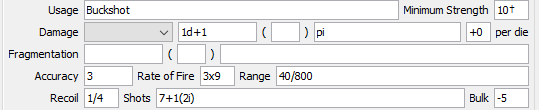
This first section is where you add the usage of attacks. Some weapons have different styles of attacks- such as stabbing with a sword instead of swinging it- and others have numerous types of ammunition that can be used (such as the Buckshot/Rifled Slug shown above). 

The red circle in the image above shows where the + and - buttons to add and remove a weapon usage are located. They do not render (but function) properly on some Windows computers, a known bug.


The second section deals exclusively with the damage line that will show up on your eventual sheet. Most of what is here is strictly what you see is what you get (WYSIWYG). All of the fields have helpful mouse-over text to denote what they are.


This last section hooks up the specific piece of gear to the skills on the character sheet, so that its specific entry in the weapons on your character sheet can be calculated correct. (Sharp-eyed readers might have noticed that I never did this for the Slug usage option, which is why it displays a level of 0 above.)

As shown above, you can specify way more than just 1 of these- allowing defaults to be handled pretty elegantly.

The first box (going left to right) is for the skill, and the second is for a specialization, if any. Both of these fields are case sensitive and won't work well with typos or misspellings.

The third box circled in red is the one you want to edit to emulate bonuses such as weapon bond that improve skill ONLY for that particular piece of gear. (EDIT: Turns out with a recent update the features tab now has a selection for "to this weapon" for Weapon Damage Bonus and Skill Level Bonus, which is awesome and makes the work-around above obsolete for some use cases.)


GCS will default to displaying the highest valid option on the final stats on the character sheet.


The fields for a melee weapon are very similar, but omit rate of fire, range, and such in favor of Reach, Parry Modifier, and Block Modifer fields. Again, most of the fields are WYSIWYG. 

Prerequisites:

This tab allows you to specify traits that are necessary to use the item. Without them, the item will show up in Red Text on the character sheet. This is normally more of a concern for checking for advantages or skills, but maybe your sword requires Magery or high IQ to wield or something. Fairly self-explanatory.

Features:


This tab allows you to attach bonuses and penalties of various types to the item, which will always be in effect as long as it's equipped. This is best suited to bonuses that are passive and constant, such as the DR afforded by wearing armor, or the Strength Bonus granted by wearing enchanted gauntlets.

Notably, the "Gives a weapon damage bonus of" field is where you'd want to look for setting up traits such as Weapon Master, Trained by a Master, and the damage bonuses afforded by Karate (although some skill entries also use this field, so make sure you're not double-dipping if you want to avoid GM ire.)

Modifiers

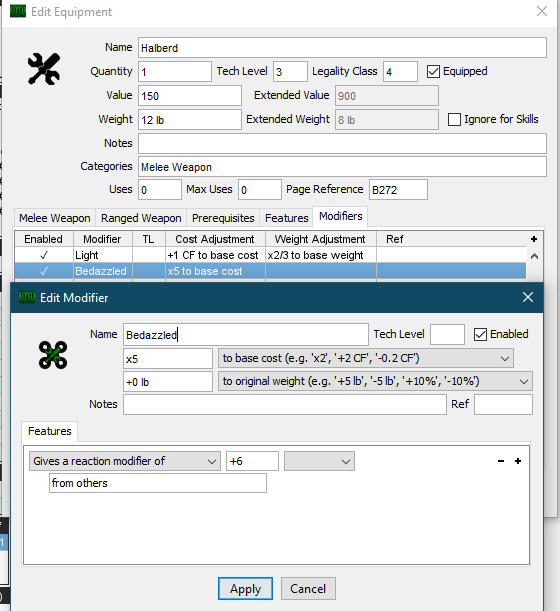
This is the latest addition to the equipment tabs, and it's a doozy for all of you who want a Bedazzled Light Halberd. Some of the options overlap with those in the Features tab- but modifiers allow you to affect the weight and value of the equipment at the same time, making it very flexible.


Take note of the Extended Value entries above- they differ quite a bit from the base Value and Weight!


Saturday, July 11, 2020

The Basics of Using GCS

Someone on a Discord server I frequent was attempting to learn the ropes of GCS, and was unimpressed with the level of documentation available on how to actually utilize the program.

I've been using GCS for years as I've found it to be a very convenient and powerful tool for making character sheets. I consider myself a bit of a GCS power user, so here's the start of what may become a series of posts on the basics of using the program. (In fact, part 2 dealing with equipment is now up!)

When you first create a new character sheet, you'll be presented with a blank sheet filled with some pregenerated character fluff (Height, weight, eye color, etc), and baseline GURPS stats.


Click to Expand

Of note, the Master Library contains the bits and pieces you'll most likely want to add to a character sheet- advantages, disadvantages, and skills. The libraries for Basic Set Advantages and Basic Set Skills will likely be where you'll spend the majority of your time searching for what you want to add to your characters.

Most tabs will have a blank line at the top that functions as a search bar, as well as a drop-down that usually filters by categories.

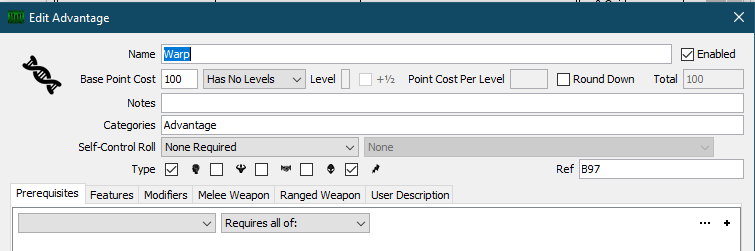
I've typed warp into the Basic Set Advantages Library here


On a character sheet, blue text means that that field can be directly edited. The fields for your stats (ST, DX, IQ, etc) will decrement unspent points appropriately as they are increased. Additionally, GCS will update derived stats appropriately (increasing DX will increase related skills, and basic speed calculation, for instance).

Some traits have way more modifiers
than others...
To add something from a library to the character sheet, you can either drag and drop it onto the sheet, or hit CTRL+SHIFT+C. Depending on the trait being carried over, a dialog box might open with modifiers related to the trait- CR ratings for disadvantages, enhancements for advantages, etc.

To edit a trait in GCS, either double-click on it, or select it and hit enter.

For advantages and disadvantages, the top portion contains fields for how to price the trait, as well as fields that help with categorizing it.

The dialog window that opens will also usually include the following tabs for most traits, including equipment:
  • Prerequisites- These will turn a trait red if your character fails to have the listed traits. (Example: Cinematic combat skills without Trained by a Master or Weapon Master.)
  • Features- These are how you can tell GCS that an advantage should give a modifier to a character- such as voice improving reaction modifiers and giving bonuses to certain skills, combat reflexes increasing defense scores, or the damage increase Striking ST gives to attacks
  • Modifiers- these are the limitations and enhancements present on numerous advantages and disadvantages
  • Melee Weapon and Ranged Weapon- these tabs allow you to specify that an attack should appear on your character's sheet, and allow you to define the statistics of those attacks
  • User description is a field that allows for entering notes.
Skills have largely the same dialog window, but have a tab for Skill Defaults, and the top portion has different fields specific to skills, which I'll drill down deeper into in a future post.


Friday, March 13, 2020

Modeling Osteogenesis Imperfecta in GURPS

Osteogenesis imperfecta (OI) is a congenital disease where the body doesn't produce collagen in sufficient quantity or quality, depending on the specific type the subject has. Due to this, people with the disease break bones very easily. It's more commonly referred to as Brittle Bone Disease.

OI Can generally be split into 3 Types:
  • OI Type 1- the mildest form of the disease.
  • OI Type 2- normally fatal within the first year of life
  • OI Types 3+- Moderate to severe types of the disease with differing clinical presentations

My friend has OI Type 4, which is a moderate to severe type. They broke her foot attempting to walk across concrete in socks. Accidentally kicking the leg of their bedframe broke their toe. A fall in the kitchen broke their elbow. They've cracked ribs, herniated a disk in their back, and had a metal plate in their elbow to correct a break from before I met them. To say that OI doesn't seem like an appealing Player Character trait is entirely accurate, as I'll illustrate below.

OI leads to numerous effects that could be relevant to a GURPS character, which I'd consider core to the trait:

  • Propensity for bone breaks
  • Hypermobility (A propensity for dislocated joints)
  • Chronic pain
  • Distinctive Blue Sclera
Let's start by modeling the bone breaks. Let's flip Injury Tolerance (Unbreakable Bones) on its head, and then address the duration of crippling injury.

Injury Vulnerability (Easily Broken Bones) [-10 or -20]: Your body is especially vulnerable to crippling injury.
Mild: Your limbs become crippled when they take damage over HP/4. Your extremities become crippled when they take damage over HP/6. -10 Points.
Severe: Your limbs and extremities become crippled when they take damage over HP/10. -20 points.

Injury Vulnerability (Long-lasting Crippling) [-10]: When you roll HT to see if a crippling Injury is Temporary or Lasting, you roll at HT-4.

Now for modeling the frequent dislocations, I suggest using the rules for Bad Back- the rules fit suffering painful dislocations very well.  

Likewise, Chronic Pain also works right out of the basic set. I could see mixing the triggers of Bad Back and the effects of Chronic Pain to simulate bouts of pain triggered by unwise physical activity, which is true to my experiences with my friend.

Distinctive Features covers the Blue Sclera as a Quirk.

Now in real life, OI can lead to additional effects, some of which will come down to a case-by-case basis:

  • Hunchback, per basic set, in the case of deforming types of OI
  • Lame (Crippled Legs or Paraplegic), or One Arm, or No Manipulators in the case where OI leads to compression of the spine, resulting in nerve damage that causes one to use the use of their arms/legs.
  • Loss of Basic Move

And for Cinematic Icing:
  • Flexibility (Double-Jointed), if the Hypermobility has beneficial uses, although people with Ehlers' Danlos Syndrome are better fits for it.
  • Bonuses to Weather Sense, or Detect (Low Pressure Atmospheric Conditions) since we all know bone breaks react to atmospheric pressure.

Sunday, December 15, 2019

My first rules botch- Stratego

My mother has a battered set of Stratego, an older version released sometime in the late 80s or early 90s. A blue bomb piece was missing, but we usually compensated by making red remove a bomb as well. I was taught by my mom, and frequently played with my cousin Sharon while she babysat me as a young kid.

Stratego seeks to emulate Napoleonic Wars of attrition, featuring a constrained map where pieces move one square at a time and the main approach to your enemy is three two-square wide channels with impassable lakes or the board edge to the left and right.

The victory conditions in Stratego are simple- kill every piece your enemy has that can move (Flags and Bombs are immobile), or capture the enemy's flag.

Stratego is a meat grinder. The strength of pieces is known only to their player- and all pieces are rated on a 10-point scale for strength. In older versions, smaller numbers were stronger, much like AC in 2ed AD&D (Which I'll use here). You can only discover the strength of opposing forces by attacking- a risky venture as discovering that you just walked your 7 into your opponent's 2 means losing the 7. Ties result in both pieces dying in a Pyrrhic Victory.

My family generally played with the following understanding:

  • Scouts (9) can move and attack in the same turn
  • Bombs destroy any attacking piece that is not a Miner (8). When attacked by a Miner the Bomb is removed. Bombs are not removed upon killing attacking pieces.
  • Victorious attacking pieces advance into the square of the defeated piece
  • Victorious defending pieces do not advance into the square of a defeated attacking piece
  • Moving a non-scout piece to the far end of the board (similar to a pawn advancing in chess) allows you to rescue a formerly captured piece, which is placed on your starting side of the field. This may be done 3x per game, but each individual piece may only rescue once.

But, Sharon and I didn't read the rules closely enough, because there's this cool piece called the Spy.

At the top of the Stratego foodchain, you have the Marshall (1). The Marshall is a force of nature, capable of cutting down swathes of troops, only challenged by Bombs and the enemy Marshall in the absence of the Spy. 

The Spy is squishy, and dies to any attack, while also dying when attacking other pieces. But, if the Spy Attacks the Marshall first, the Marshall dies. At that point the Spy can just sit around body blocking, preventing Scouts from blazing across the battlefield and taking unprotected flags, or something I guess.

But Sharon and I didn't understand the rules that way. We'd unknowingly played with a much deadlier set of rules:

If the Spy Attacks, it wins (except against bombs). If the Spy is attacked, it dies.

This made a game that was already a stark look at attrition and added a game of monstrous glass cannon chicken into the mix as well. The spy could annihilate and cut through an opposing enemy army, but any scout could quickly end its reign. Attacking the wrong bait could cause the Spy to advance into the defeated piece's space and fall victim to a piece lying in wait.

Previously, the Spy was best used hidden, unobtrusively placed to sneak out and get the drop on the Marshall, a contingency to the piece in the game meant to be a force of destruction.

With our rule, what was an elegant and subtle duel became a frantic dance to find an opening that would allow for taking out one of the deadly duo, without losing half of your own in the process.

Now that I'm significantly older, I've played Stratego with both sets of rules. As far as screwing up rules go, the unintentional change we made to the Spy wasn't game-breaking, unlike the scores people who never ran auctions for unpurchased Monopoly properties (let alone the insanity of allowing free parking to accumulate a pool of money).

I'd say that this rules botch is a viable rules variant. It can overall speed the time a game of Stratego takes because of the rapid death experienced by armies as the deadly duo comes through town, and it simplifies the Spy's role by making its interactions with other pieces more universal. Highly suggested when playing with young kids looking for a more action-packed board game.